Author: Paul

  • Are CDs back next?

    Are CDs back next?

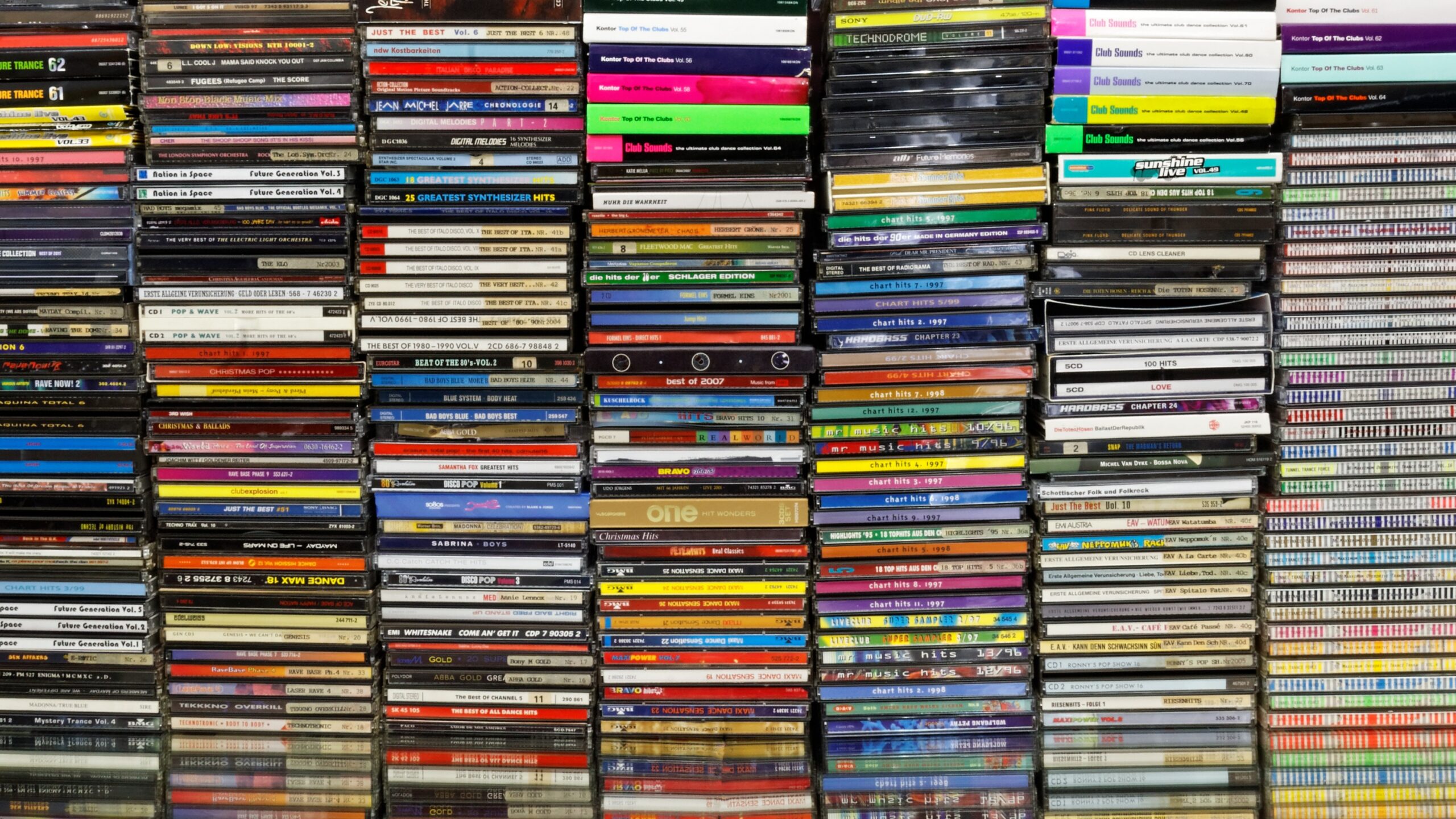
    If you’re looking to get (back) into the venerable Compact Disc, you’re not alone. While we all keep hearing how vinyl record sales are soaring, a big reason for this is down to how surprising it is. To most of us that grew up with vinyl records, it is simply shocking. It is true though that in 2022, vinyl record sales surpassed those of CDs, but in reality, and according to Consumer Reports, more Americans listen to CDs than vinyl records. Their survey only involved 2,022 adults, so not a huge sample by any means, but it’s still telling. And with vinyl record prices being as high as they are, CDs might be right format to get into now.

    As both a recording engineer and a recording artist, it is no secret I believe digital is the better format. Hold on, put down your pitchfork; when I say better, I mean it preserves the original reproduction closer to the source. You know the “Fi” in “Hi-Fi”? It stands for fidelity. I believe an uncompressed, high quality digital file is far more loyal to the original source as any other format. Vinyl is awesome, don’t get me wrong. I’m known to romanticize analog audio formats, but they introduce a lot of character that wasn’t necessarily there in the performance.

    SPARS codes on various 1980s Decca CDs

    tangent one: SPARS code

    Most recordings since the late 70’s have been recorded to a digital format to allow mixing to take place without losing quality. This is where the DDD, ADD and AAD codes in compact discs comes from. If you’re under the age of 30, you’ve probably never seen this though. This is called a SPARS code, which stands for the Society of Professional Audio Recording Services. And while it’s used to describe the provenance of a recording, it’s most often used in CD’s containing music of a certain vintage. The decoding of the three letter code is not complicated and would immediately tell you more about the recording in the album you’re looking at.

    The first letter indicates the type of audio recorder used during initial recording (analog or digital).
    The second letter represents the type of audio recorder used during mixing.
    And finally, the third letter is for the type of mastering used (digital for CD releases, analog for cassette and vinyl).

    So by this logic, a CD would always have a “D” as the third letter in its SPARS code.

    I remember most of the albums I owned as a child, being into what we call today “classic rock”, would have AAD printed usually both on the disc and on the back of the jewel case. Informing this disc contained music recorded on an analog format, mixed in analog (i.e. tape), but then mastered for digital. This means that the original release of, say, Queen II in 1974, was all “AAA” and released in vinyl and tape formats. Only remastered to be released as a CD in 1986, earning, at that point and for those formats, the AAD code.

    a quick dissing of tape

    What about tape? We used tape for decades as a recording medium before pressing the mix of said recording onto a record, so in a way, its character is (more often than not) present in vinyl records as well. Tape has it’s set of issues, and solid reasons for me not really giving it the time of day in terms of a “cassette revival”, even though it’s the format I grew up on, and the sound shaking a cassette, and placing it into a cassette deck loader makes, is not only unmistakable, but a true ASMR moment for me. I can get into why I don’t think you should get into cassette tapes in 2025 in another post, as today we’re talking about why you should be getting into CDs instead.

    tangent two: SACD

    CDs aren’t the end-all be-all of digital formats of course, the real holy grail is SACD, which is (more) comparable to DVD-quality; with a significantly improved dynamic range to that of CDs as well as higher bitrate and sample rate it certainly makes the top of my list for high fidelity sources. But I’m not even talking about SACDs here since the discs are expensive, releases are limited and players can be hard to find. For today, I’ll stick to traditional, affordable and available CDs.

    why should you get into CDs?

    I’ll cut to the chase here, CD’s are available, you can find them used in fantastic shape for under $5 a piece, they sound great and are a honest-to-goodness physical format that you can own, feel and read through liner notes, sometimes lyrics, artist’s thank yous and enjoy without an internet connection.

    Back in my day, bands would recommend other bands they’re into in the booklet and some record labels would put hype stickers on the CD wrapper saying “FFO” (For Fans Of) to entice the audience of, say, Jimmy Eat World, Weezer, The Starting Line, Good Charlotte or Simple Plan, to buy this new “All-American Rejects” debut album.

    But you’ll need a CD player to play them. Here’s where I come in. There’s a lot to unpack here and I’ll preface this by stating I’d always suggest you pick a single tray-loading player. If you find a particularly good deal on a 5-disc carrousel cd-player, by all means, go for it. It may be fantastic. I owned a wonderful Yamaha player I bought new in 1998 that brought me decades of joy. It was wonderful to use. And my dad still uses a trusty Adcom 20-bit 6-disc changer from the early 90’s. But in general? They tend to break far more often, they make more noise and overall mean the company that made them spent perhaps more resources in making the device hold multiple discs simultaneously than they did in other aspects of the product. After I sold my Yamaha upon getting into some hard times sometime in 2009, I bought a Teac single tray-loading unit in 2017 that is still in one of my listening rooms.

    if I were buying a CD player today…

    If I were looking to buy a CD player today, and I wanted an all-in solution, I’d look into the Onkyo C-7030, Yamaha CD-S303, Cambridge Audio AXC35, or the NAD C-538. It appears as my Teac CD-P650 is now discontinued.

    Please note all the links here are Amazon Affiliate links and I may make a small commission at no cost to you if you make a purchase using these links.

    what to look for in a (vintage / used) CD player

    To keep it simple, short and sweet; look for a unit that’s well built. Nothing is worse than a cheap DVD player from Walmart that can play CDs but will look terrible in your cabinet and will shift its sitting position when you press the eject button without holding the device in place. To add insult to injury, unless you’re using a better DAC (we’ll get into this later), it just won’t sound all that good. Sure, it’ll play your discs, but it’ll produce uninspiring and soul-less music. We’ve got streaming for that.

    Look for a decent internal DAC, I’d be fine with anything that does sampling at over 10-bits. All of the linked CD players above have 24-bit DACs. Most cheap (or portable) players are all single bit DACs, it’s fine for listening on the go or in your car, but for your house, a high quality DAC ensures you’ll get more life out of the digital code the disc contains. The two better known DAC manufacturers you’ll find in the sub-$400 price range are the Wolfson and the Burr Brown. My Teac has the latter, but I prefer the sound of the Wolfson to be honest, however, not a make or break deal here. Feel free to go vintage or preowned shopping. Great CD players can be had for next to nothing. Keep in mind a lot of features tend to be accessible only through the remote control, so if these are important to you, make sure the remote is included.

    You can also give your local vintage repair center a call and ask if they’ve got any used CD players for sale as they’ll often have something they’ve already gone over to make sure everything is up to spec. Such is the case at Vintage Source, for instance.

    Other features you may or may not care much for is the ability to read MP3 files in a burned CD-R; I personally don’t care much for this feature. This used to be how I consumed music in my high school years, but these days, the CDs I’m looking to listen to are not CD-Rs, but to each their own. CD-TEXT is another feature you may or may not care (or know) about. Primarily used on Sony / BMG releases, some CD players have the ability to display Artist and Album title along with Track name in your CD players screen. Note that most CDs are not encoded with this, but I’d still say it’s a nice feature to have that, unfortunately, never took off.

    player vs transport

    A CD player can load a CD, decode it and play it. Some CD players have even a built-in headphone amplifier. A CD transport however, only loads and reads. It relays the decoding and playing to a different device: an external DAC.

    It is true though, that most CD players also have an optical output, which would bypass the internal DAC and allow you to use your CD player strictly as a CD transport, the same cannot be said of CD transports alone. Why are transports usually more expensive I hear you say? Manufacturers typically assume that if the end user is going to use their own preferred, usually higher end, DAC, they’d rather get a much nicer transport instead.

    For the most part, you can test a cheap CD player and an expensive one and as long as they’re both running through the same DAC, they’ll sound the same. There’s other things to consider here, like dithering and oversampling, but in a simplistic way, the DAC is what makes the sound. So it stands to reason you’d want to invest more on the DAC than on the transport anyway. Most AVR’s these days have an internal DAC as well so you could bypass your affordable CD player’s in favor of the one in your AVR. In my experience, however, unless you’re running a particularly high end AVR, the internal DAC on it won’t be any better than the one in a decent CD player like the ones above.

    tldr

    Overall, I believe we gravitate towards CDs for the same reason we do to vinyl: It’s a physical media, that can be held, felt and owned, as well as read about and enjoy the album art, all on its own. The same cannot be said about streaming.

    I do still prefer vinyl records, though. In no small part due to their artwork being significantly larger; but I tend to like the wearing format as well, there’s just something about physical contact. I know the CD is superior in a lot of ways, but this is music we’re talking about. Logic plays a rather small role.

    It’s a great time to get into CDs, and if you need any help navigating the growingly complicated options out there, do not hesitate to visit the Vintage Source store in Kansas City, where you might get lucky and score one of the CD players they’ve had expert technicians go over and make sure they’re running in optimal condition.

  • Replacement Stylus – Ortofon OM

    Replacement Stylus – Ortofon OM series

    If your turntable shipped with an Ortofon OM-series cartridge, you can replace a broken or worn down stylus or test other styli in the OM lineup in a matter of seconds. Here you’ll find amazon affiliate links to purchase some of the most common styli compatible with your cartridge.

    Ortofon OM 5e

    The OM 5e is where you’ll most likely start. It’s a capable, well regarded, performer at an incredibly reasonable price.

    Typically recommended for casual listeners or those just getting into vinyl playback. It’s often describes as clear and balanced, with a slight emphasis on the midrange, making vocals particularly engaging.

    Affiliate Link:

    Amazon (US)

    Ortofon OM 10

    While looks and shape, as well as the elliptical shaped stylus are extremely similar, the OM 10 is, in our opinion, a worthy upgrade if you’ll be replacing the 5e. In other words, if you need to replace your 5e, for whatever reason, there is virtually no reason not to get the 10 instead.

    It tracks at a slightly less weight, but if you don’t own a stylus scale, it’s acceptable to leave the same weight as you had on the 5e set.

    The OM 10 offers wider soundstage, delivering better clarity, especially in the highs and midrange, along with tighter bass control. Vocals tend to sound more lifelike and textured.

    Affiliate link:

    Amazon (US)

    Ortofon OM 20

    Keeping with the same body means you don’t have to mess with changing cartridges in your turntable and upgrade your sound hassle-free. If you’re looking for a serious upgrade, the OM20 is a fantastic place to be.

    The first in the lineup to offer a different stylus tip, the OM20 upgrades to a nude elliptical diamond stylus, which is more precise and allows for better and more accurate tracking and sound reproduction. This stylus also bumps up the frequency response to 25kHz (as opposed to 20Hz – 20kHz of the previous options).

    Often described as lively yet smooth, with a natural tonal balance that flatters everything from jazz and classical to rock and folk. It’s also forgiving enough for less-than-perfect pressings while still revealing the depth in high-quality recordings.

    Affiliate link:

    Amazon (US)

    Ortofon OM 30

    Moving up to the OM30 will cost a little bit more than the previous, but it might prove to be a worthwhile investment if you want to take your listening to a new level since this stylus manages to play up to 27kHz, particularly suitable for more orchestral sounds.

    It’s also an even finer stylus than the OM20, a nude fine line stylus, meaning it is even better at capturing the finest details in the bottom of the record grooves.

    While the OM 20 is often considered the sweet spot for value, the OM 30 is for those chasing that extra layer of nuance and realism.

    Affiliate link:

    Amazon (US)

    Ortofon OM 40

    While definitely overkill for one of our consoles, we’d only suggest this upgrade if you truly must have the creme of the crop, the top of the line, and honestly, would only truly be able to take advantage of this upgrade if you’re listening through more speakers throughout your house. But, for those who are seeking to get the absolute most out of their equipment, there is the OM 40, a high-performance stylus that delivers exceptional resolution, finesse, and tonal balance. Often considered one of the finest moving magnet options Ortofon has ever produced.

    Employs a nude Fritz Gyger stylus, with a highly sophisticated line-contact design allowing for ultra-precise groove tracing, especially in the inner grooves, and excels at extracting microdetail from well-pressed records. It also takes the frequency response all the way up to 30kHz.

    It demands meticulous setup though. VTA, azimuth, and anti-skate need to be dialed in carefully, otherwise it may sound too bright and unforgiving. Some people prefer the OM 30 for its slightly warmer, more forgiving presentation.

    Affiliate link:

    Amazon (US)

    Other styli compatible with your OM cartridge that deserve consideration (at varying price ranges)

    Ortofon OM 14

    As you may expect, this stylus sits somewhere between the 10 and the 20 in the lineup. It focuses on specific characteristics; in this case, light tracking force. Because of this, it is often recommended as a budget-friendly option for those with particularly valuable pressings.

    Often described as clean and neutral, with a touch more refinement than the OM 10, especially in the treble. It doesn’t quite reach the resolution of the OM 20’s nude elliptical, but it’s a solid performer for the price.

    Affiliate link:

    Amazon (US)

    Ortofon OM Pro S

    A variation of the OM10, focuses on being able to withstand higher vertical tracking force (i.e. weight), making it a great option for DJs.

    Described as warm and punchy, with a focus on midrange and bass. It’s not as detailed or refined as the OM 20 or OM 30, but it’s surprisingly musical for a DJ cartridge. Some listeners even find its conical stylus gives a smoother, more forgiving sound on worn records.

    Keep in mind its recommended tracking force is 4g (vs the usual ~2g in most of the rest of the lineup), so be sure to get a scale to adjust your counter weight.

    If you often experience skipping or other issues with your records, this might be worth the try.

    Affiliate link:

    Amazon (US)

    If you’re unsure which you need or want to have a conversation to determine what stylus is the best suited for your needs, feel free to contact us! We’d love to hear from you!
    Don’t forget to attach a photo of your record player.

  • Replacement Belt – Pro-Ject Elemental (PN 1940 675 222)

    Replacement Belt – Pro-Ject Elemental (PN 1940 675 222)

    Belt Replacement – Pro-Ject Elemental

    Most of our early models were built using the Pro-Ject Elemental. This turntable is now discontinued, but the part number for the belt is 1940 675 222.

    If your record player looks like the ones in the pictures, or it was purchased before 2023, you’ll need this belt.

    Amazon (US)

    If you’re unsure, you can always contact us and ask what belt your record player needs. Don’t forget to attach a photo of your record player.

  • RCA Annapolis

    RCA Annapolis

    RCA Annapolis

    RCA Annapolis

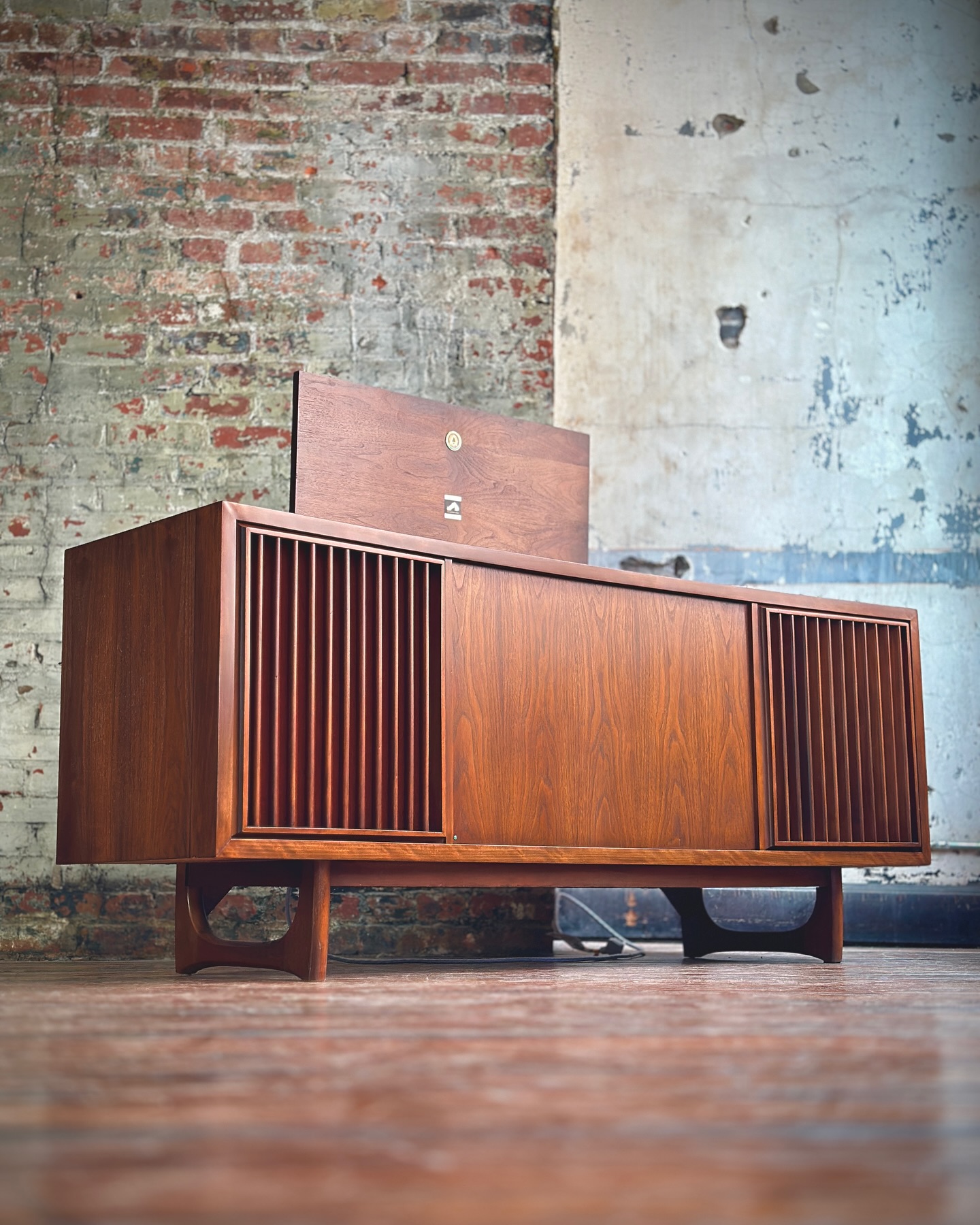
    One of our favorite consoles, which we continuously try to get more of, is certainly the RCA Annapolis. With its curved front and slatted speaker grilles, this console’s design bleeds MidCentury Modern. No console have we restored and retro-engineered more of than the Annapolis. At one point, we were working on three of them at the same time and discovered that no matter how similar they look, they all sound different and therefore require just as much individual attention.

    Built and sold over the course of a few generations, through which the main cabinet remained unchanged, with just a couple of tweaks and two different amplifiers (as well as a larger model — dubbed “The Manhattanite”, that has somehow eluded our attempts to restore one), it is still one of the most iconic stereo console designs of the 1960’s.

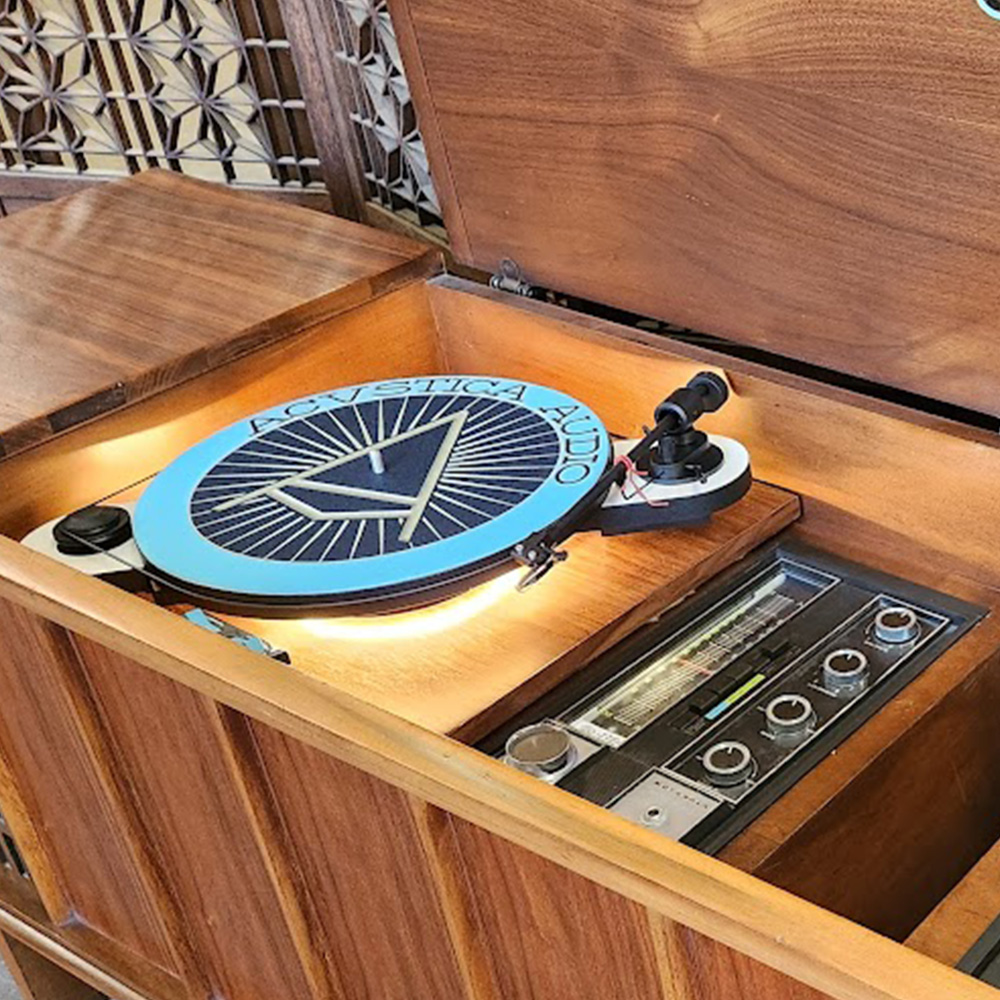
    Acvstica Audio RCA Annapolis
    Photo Credit: Vintage Source

    By the time we’re done with this piece, it’ll have our usual stack of components and features:

    • Wi-Fi, fully compatible with Spotify Connect, Apple Airplay and more.
    • Bluetooth
    • TV-Ready Optical Input
    • Audiophile-grade Record Player
    • Custom tuned amplifier & speakers

    Check out what this looked and felt like in our last Annapolis!

    Acvstica Audio Youtube Channel
    RCA Annapolis advertisement

    Most RCA Annapolis’ we’ve retro-engineered were built between 1965 and 1969.

    All of our consoles, speakers and radios go through an extensive bespoke tunning using a professional calibration microphone and computer software, which then gets written into the amplifiers DSP (Digital Signal Processor) firmware. This is done in order to achieve outstanding fidelity and performance.

    Any more questions you may have feel free to call us at (913) 243 5913 or visit our shop at Vintage Source where we’re always happy to talk audio and show you around.

    Subscribe to our newsletter!

  • Grundig 2066

    Grundig 2066

    Grundig 2066

    This vintage Grundig radio showcases our transformation of the 1958 Grundig 2066 into a modern streaming machine. By integrating JBL speakers, custom amplification, and wireless streaming, we preserve the charm of vintage design while delivering high-fidelity performance.

    We picked up this 1958 Grundig tabletop radio with a blown (single) speaker and burnt out amplifier to restore and retrofit not knowing how well it’d turn out.

    Inside the Grundig 2066: From Mono to Stereo

    Usually preferring buying broken down radios, we never know what to expect. Especially when ordering online. In this case, it only took a deep cleaning and some light buffing at Vintage Source to make its wooden case shine. The audio however, was a different story.

    Every Vintage Grundig radio retrofit we build is tuned for clarity, warmth, and reliability and this one is no different. We started by replacing its mono speaker with a stereo set from JBL with concentric tweeters.

    After installing our custom tuned amplifier we wired the volume control to the original volume knob and kept the original clacky buttons performing some modern functions — off, on and input selection, cycling through Wi-Fi Streaming (for Spotify Connect, Apple Airplay and more), Bluetooth, and even an aux-in port in the back.

    This custom retrofit honors the Grundig legacy while delivering modern performance and convenience. But don’t let it’s compact size fool you, it gets loud while keeping a clear, crisp, hi-fi sound.

    Want your own? Check out current inventory and availability in our order page.

  • Neckermann-Körting Radio

    Neckermann-Körting Radio

    Neckermann Körting

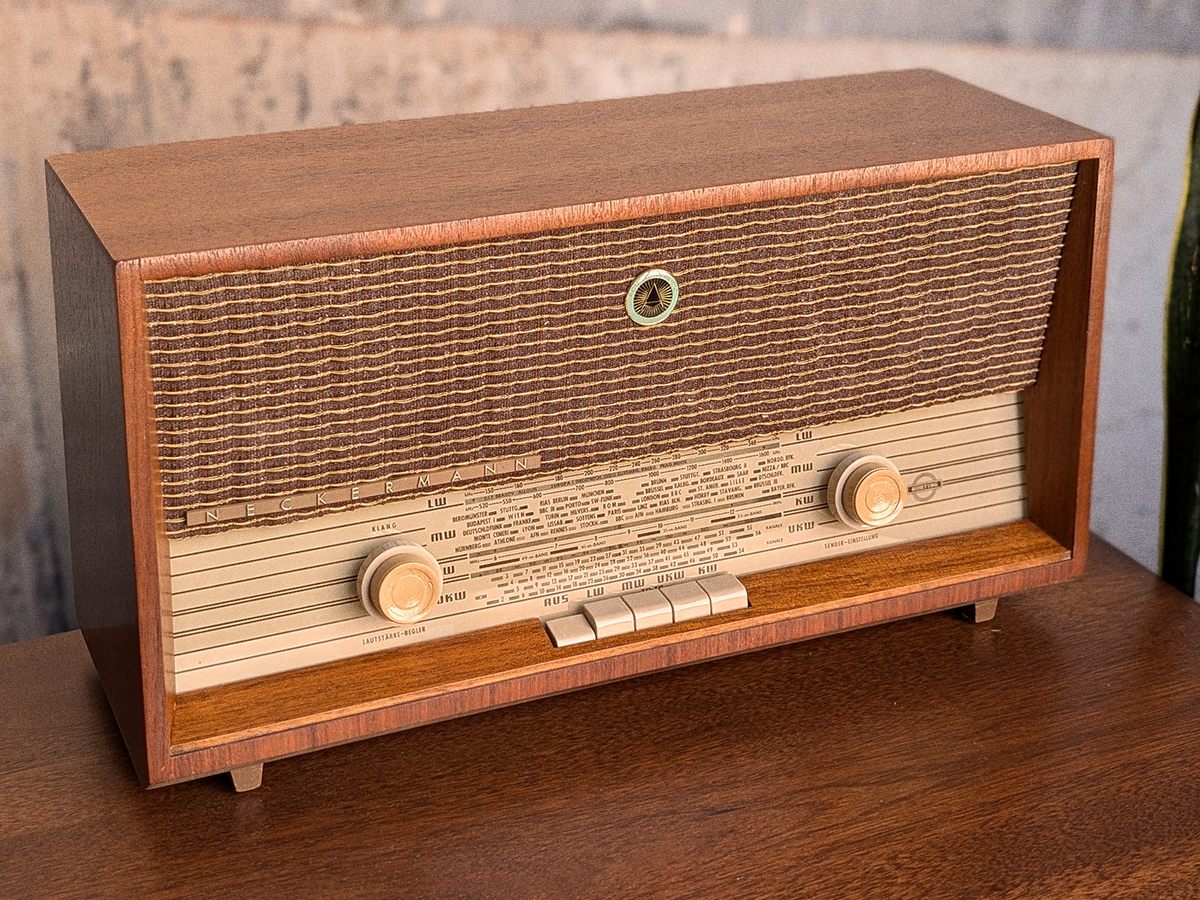
    This Vintage Körting fully retrofit radio transforms the Neckermann 1035/60 into a modern yet elegant tabletop streamer. Built in the early 1960s, the compact radio arrived in rough condition after spotted on eBay. Its blonde tuner plate and understated cabinet made stood out enough to take a chance, sight unseen.

    Following a full cabinet refinish by Vintage Source, we focused on preserving the original look and dial glass. Inside, the mono speaker was replaced with a stereo set from Polk Audio, paired with a custom-tuned solid-state amplifier engineered for clarity and warmth. The original volume knob now seamlessly controls the new amp, while the factory buttons remain functional: the “aus” button powers the unit off, pressing any other button switches it on and the far-right button has been modified to act as an input selector.

    Polk Audio Drivers and Solid-State Amplification

    This retroengineered Körting now supports Bluetooth, Apple Airplay, Spotify Connect, Roon and a wide range of streaming services via Wi-Fi. To support legacy devices, we discreetly installed an aux-in port on the rear panel. This addition enhances compatibility with older sources and allows users to integrate vintage gear without sacrificing convenience or quality. It complements the system’s modern streaming capabilities by offering a tactile, analog option for purists and collectors alike. Thanks to a redesigned internal layout, the stereo imaging remains clean and balanced with minimal resonance, making it ideal for small spaces without compromising fidelity.

    Whether placed on a shelf, sideboard, or desk, the piece adds a touch of elegance while delivering modern functionality. In essence, it reflects Acvstica Audio’s commitment to preserving design heritage and elevating sonic performance.

    Want your own? Check out current inventory and availability in our order page.

  • Grundig Lautsprecher Box IV

    Grundig Lautsprecher Box IV

    Grundig Lautsprecher Box IV

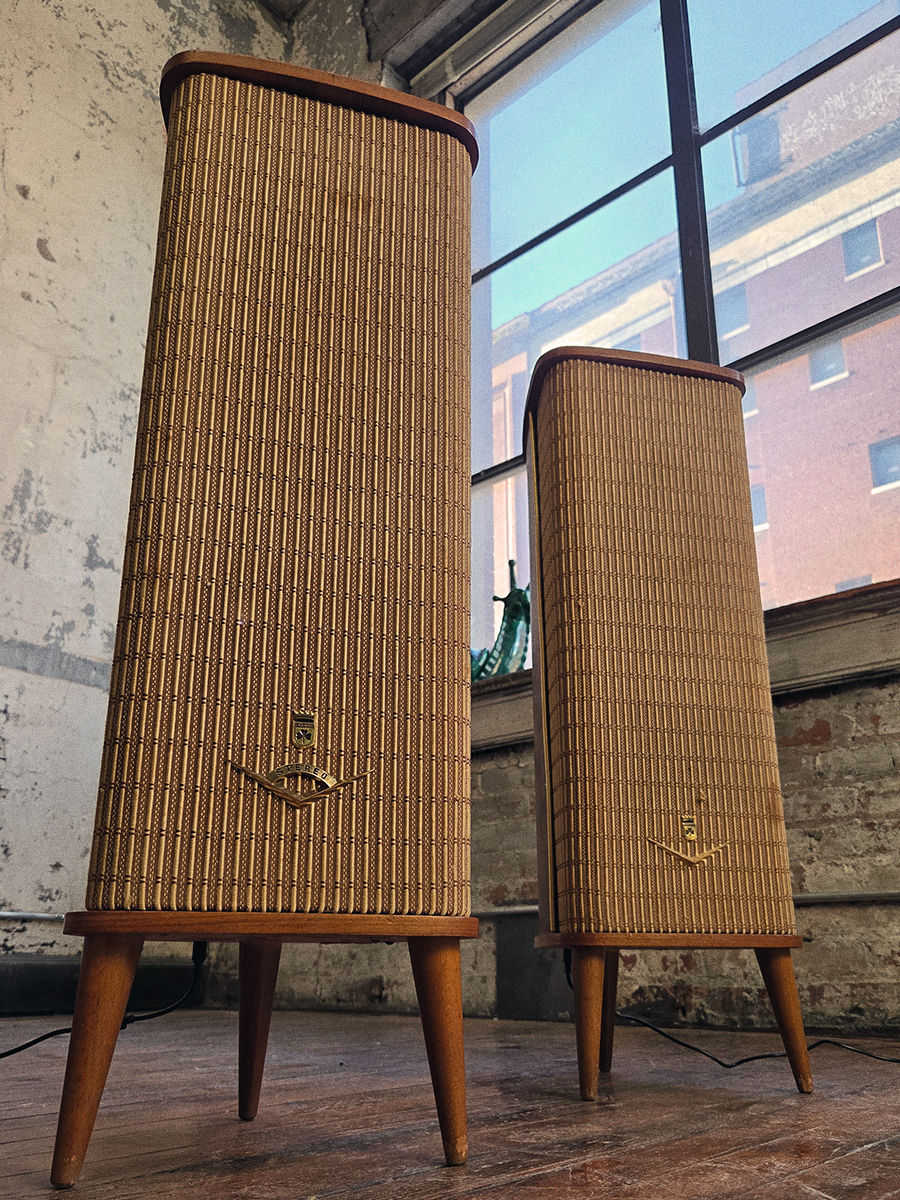
    I’ve wanted to own and restore a set of these speakers since forever. And I finally got the chance. I definitely overpaid for them, and they were the higher end model that included a vacuum tube amplifier inside each. Definitely the earliest powered speaker I’ve ever known of. The date I found in them was sometime in 1959. I wanted to replace the speaker cloth, but none of my sources had anything nearly as cool as the original, so we left the grime and patina as it was and gave them a new set of carbon fiber woofer speakers with AMT tweeters as well as a power amplifier with our custom tuning. They sold before I could even think up how much should we ask for them. Fortunately though, they went to an amazing family that also owns a Relikcs Timbre console in Omaha.

    Want your own? Check out current inventory and availability in our order page.

    Check out our basic operation video for these speakers and subscribe to our YouTube channel!

  • Zenith Y960

    Zenith Y960

    Zenith X930

    Zenith Y960

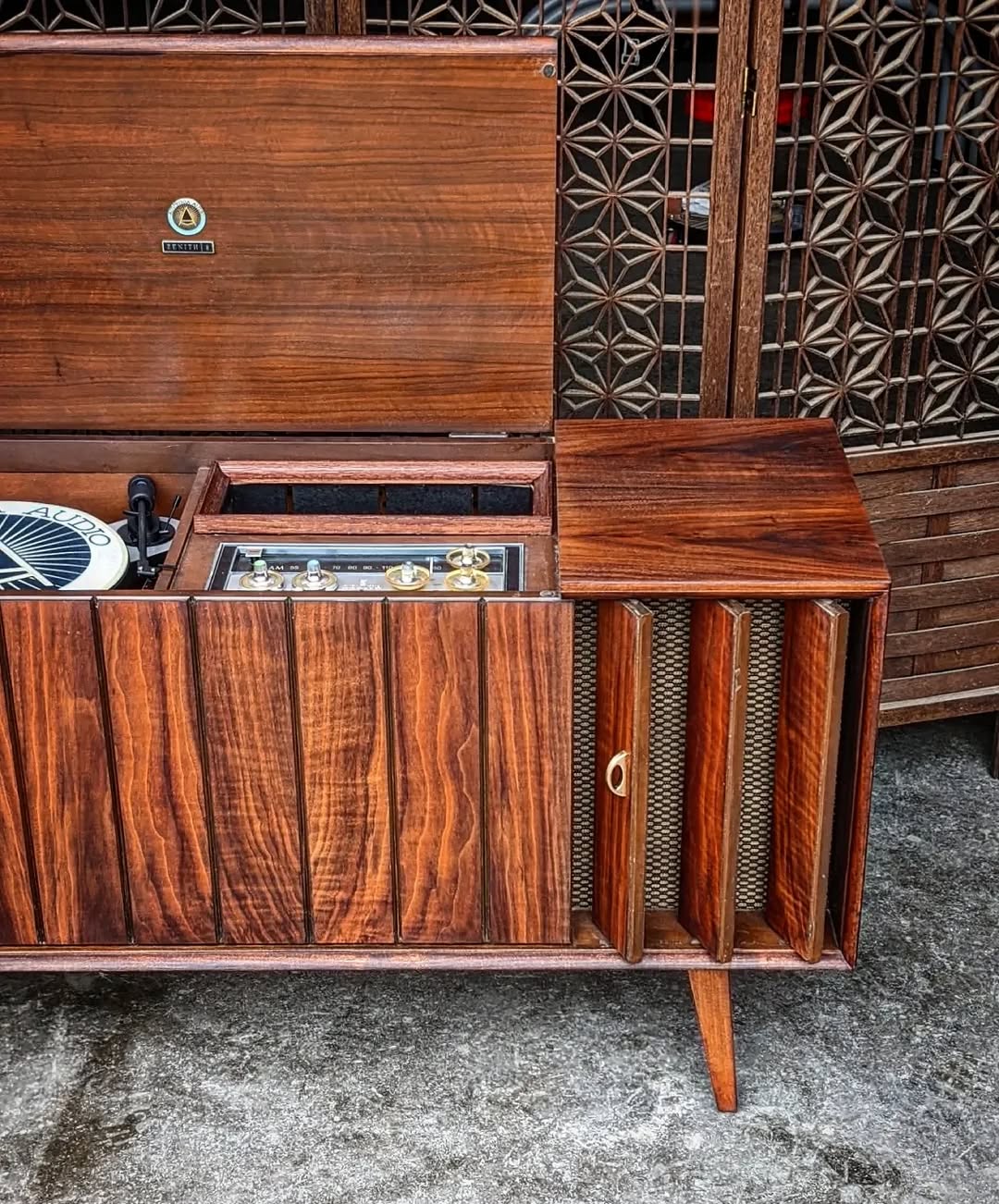
    Few consoles capture the Mid-Century Modern aesthetic quite like Zenith’s Louvered Door consoles. We’ve restored several over time and always admire the timeless elegance of these designs. Though not particularly rare due to their long production run, a well-preserved example remains a true statement piece.

    Over roughly a decade of production, Zenith continually refined its models while maintaining the signature look and feel—wider, deeper cabinets, with or without open-reel tape decks, and Danish or Modern-style bases.

    We currently have three different cabinets, including two of the larger Y960s. One is a YT960, displayed unrestored at Vintage Source‘s showroom. Unfortunately, its lifting R2R tape deck was removed long before it came to us, so we’ll repurpose the space as a storage cubby. The third console is a more compact model that keeps the same overall aesthetic.

    Picture of a Zenith Z930, restored by Vintage Source, Retro-Engineered by Acvstica Audio.
    Photo credit: Dan Posch
    Zenith X930

    Once restoration is complete, this console will feature our custom selection of premium components, including:

    • Wi-Fi, fully compatible with Spotify Connect, Apple Airplay and more.
    • Bluetooth connectivity
    • TV-ready optical input
    • Audiophile-grade record player
    • Custom tuned amplifier and speakers
    Zenith x930 advertisement

    The console pictured here is a retrofit we had refinished by what is now Vintage Source, back in 2022.

    The Zenith X930, built in 1966 specifically.

    Zenith provided little documentation regarding model variations and production dates for this design style, but we’ll continue updating this page as we uncover more. We aim to be a reliable resource for verified information on these consoles.
    Currently, our collection includes a YT960 (sans tape deck), a Y960, and a smaller unidentified model, all boasting Zenith’s iconic louvered doors

    Every console, speaker, and radio we restore undergoes extensive bespoke tuning using a professional calibration microphone and advanced software. The resulting data is programmed into the DSP (Digital Signal Processor) firmware, ensuring exceptional fidelity and performance.

    Any more questions you may have feel free to call us at (913) 243 5913 or visit our shop at Vintage Source where we’re always happy to talk audio and show you around.

×